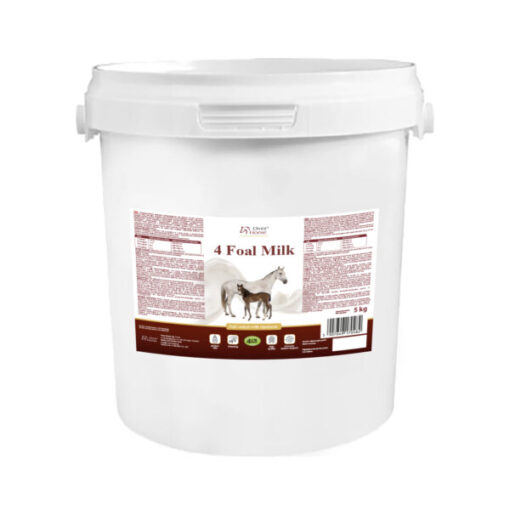
Foal milk powder 5kg
$ 97.26
Description 4 Foal Milk is a high quality milk replacer for foals. Its formula was developed by veterinarian Wojciech Piekałkiewicz at the Rzeczna Equine Clinic in Poland. This product can successfully replace the mother hen's milk from the first days of the foal's life. In cases where the young foal's diet needs to be supplemented, 4 Foal Milk is the ideal solution. This foal milk powder is made from delicious and GMO-free ingredients. Its balanced composition ensures the harmonious development of young animals and prevents vitamin and mineral deficiencies. In addition, the added beta-glucans and polysaccharides from the yeast strain Saccharomyces cerevisiae effectively support the immune system. The professionally developed formula ensures that the milk is as close as possible to natural mare's milk. can be given to the foal from the first day of life can be a full substitute for mare's milk can be used as a supplement to mare's milk if necessary Why choose this: professional recipe developed by a veterinarian a proven product in the rearing of many foals GMO-free ingredients supplementing the foal's diet with essential vitamins and minerals in the correct dose and proportion supports the foal's proper development contains ingredients that stimulate the immune system of foals Apply at: Dissolve 125 g of powder in 1 litre of water at 42-44°C. Serve at 38-39°C. The quantity and frequency of administration depends on the age of the foal and its individual characteristics. Kor Number of feedings per day One serving (ml) 1 week 12-16 100-200 2-4 weeks 11-9 250-600 5-8 weeks 8-6 650-1450 >9 weeks old 5-4 1500-2000 The recommended amounts are only a guide, get the foals used to it in the first week and drink small amounts every half hour. As the appetite increases and the foals' general health improves, increase the dose according to individual needs. After watering, the pans should be washed with particular care. Always have clean fresh drinking water and high quality hay in front of the foals. Already after two weeks of age, he gives the Equusline Optima foal milk. Form: dust How to feed: the resulting solution should be given directly into the mouth from a bottle with a pacifier or from a bucket. Complete milk replacer for foals. Keep in original packaging in a cool, dry place, out of the reach of children. Protect from sunlight. Not freezable. Ingredients: demineralised whey powder, sweet whey powder, skimmed milk powder, whole milk powder, vegetable oils and fats (palm, coconut, non-GMO rapeseed, sunflower), milk fat (butter), hydrolysed wheat protein, wheat flour, non-GMO maize starch, non-GMO dextrose, yeast and parts thereof of the strain Saccharomyces cerevisiae (including beta-glucans), magnesium oxide, glycerol, propylene glycol Additives in 1 kg: Technological additives: 1a: formic acid (E236), fumaric acid (1a297), orthophosphoric acid (1a338), citric acid (E330), calcium formate (1aE238), 1b : BHT - butylated hydroxytoluene (E321) 0,83 mg, BHA - butylated hydroxyanisole (E320) 0,10 mg 1i : Anti-caking agent - precipitated and dried silica (E551a) 1,25 g, colloidal silicon dioxide (E551b) 0,25 mg 2b: Flavouring mixture 0,6 g Summary: 3a: vitamin A (retinyl acetate 3a672a) 23900 IU, vitamin D3 (cholecalciferol 3a671) 4010 IU, vitamin E (all rac alpha-tocopheryl acetate) 150 IU, vitamin C (ascorbic acid 3a700) 150 mg, vitamin K3 (3a710) 4 mg 3b: Iron (3b103 iron(II) sulphate monohydrate) 86 mg, Copper (3b405 copper(II) sulphate pentahydrate) 11 mg, Manganese (3b503 manganese sulphate monohydrate) 40 mg, Zinc (3b605 zinc sulphate monohydrate) 159 mg, Iodine (3b202 anhydrous calcium iodate) 1.69 mg, Selenium (3b801 anhydrous sodium selenite) 0.219 mg Zootechnical data: 4b :(4b1700i) Bacillus licheniformis/Bacillus subtilis 1:1 -1.3x10e9 CFU Analytical ingredients: Crude protein (Kjeldahl protein determination) 21,0% Crude fat 15,5% Crude fibre 0,01% Nyershamu 5,5% Calcium (Ca) 1.0% Phosphorus (P) 0,7% Sodium (Na) 0,3% Lactose 46,0% Magnesium 0,1% The concomitant use of different organic acids or their salts is contraindicated if at least one of them is used at or near the maximum permitted level.